



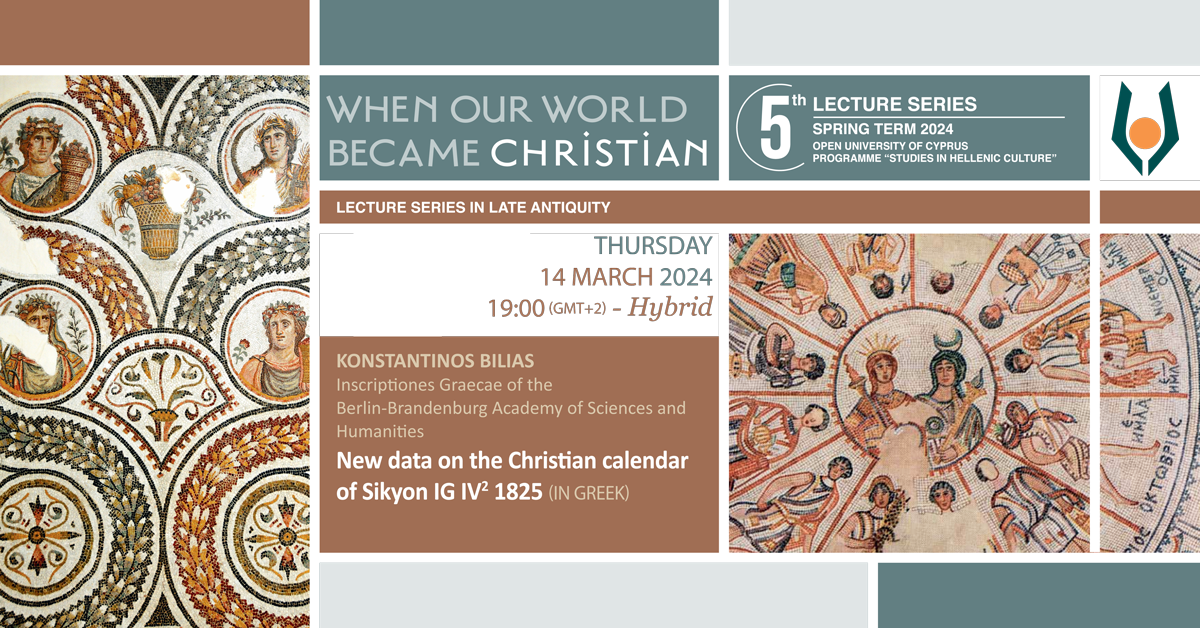
Τhe Programme "Studies in Hellenic Culture" of the Open University of Cyprus (OUC) is organizing the 5th Cycle of the Lecture Series in Late Antiquity with general title: “When our world became Christian”. The Lecture Series examines various aspects of the period known as Late Antiquity but tends to focus on issues of Christianization, Late Antique Archaeology, and the Eastern Roman Empire. The second lecture of the Series is entitled “New data on the Christian calendar of Sikyon IG IV2 1825”, and will be delivered in Greek by Konstantinos Bilias, assistant in the Inscriptiones Graecae of the Berlin-Brandenburg Academy of Sciences and Humanities. The hybrid event be held on Thursday, 14 March 2024, 19:00 (GMT+2) at the Main OUC Building (33, Yiannou Kranidioti Avenue, 2220 Latsia) in Nicosia, and will be broadcasted live through OUC’s eLearning Platform (eClass) at the web link: https://shorturl.at/kBIOW.
Convenor of the Lecture Series is Associate Professor Georgios Deligiannakis, Programme "Studies in Hellenic Culture". The Series is supported by the Student and Alumni Union of the Programme and the Cyprus Broadcasting Corporation.
Inscriptions constitute without doubt the most secure evidence for the identification of saints’ cults and for documenting socio-political and religio-cultural realities according to their context. A unique example for cult’s canonisation in early Christianity is the “Parapegma of Sicyon”, a calendar of saints' feast days, dated in the 5th century AD. This Greek-language peg calendar combines a Latin calendarian structure with the allocation of each day to a saint. The talk aims to present three new fragments of this inscription found in the Museum of Sicyon. The nine new saints’ names confirm the impression given by the already known fragments, that no clear separation between saints of the Western and Eastern Church was made by that time and raises questions about the timing of feasts throughout the year. Furthermore, the inscription’s archaeological context will be taken into consideration, since it was found next to the pagan temple of Sicyon, which was converted to a Christian Basilica in roughly the same period as the calendar’s date. The identification of these new fragments brings us closer to the reconstruction of a local calendar, an eloquent evidence of a time of changes and transition from pagan to Christian cult.
Konstantinos Bilias studied in Berlin and Rome classical archaeology and philology with focus on ancient Greek religion and rituals, epigraphy and sacred topography. He has participated in various excavations in Greece, Cyprus and Italy and in international projects and conferences. He is currently working as assistant in the Inscriptiones Graecae of the Berlin-Brandenburg Academy of Sciences and Humanities, and doing his PhD on the inscribed bronze tables from Olympia.
